
Choose Your Perfect West Lothian Domain Name in Under 15 Minutes
Your domain name is your business's digital front door. It’s often the very first thing a potential customer in West Lothian sees and, crucially, the main way they'll remember how to find you online. Think of it less as just a web address and more as a powerful piece of your brand.
What Makes a Great Domain Name

When you're brainstorming, the real goal is to land on something that feels simple and intuitive. It needs to click with your brand's identity. For a local business in Livingston, for instance, a catchy and easy-to-recall name will always win out over something long and complicated.
Before you even start searching for availability, it helps to get your head around what makes a good brand name in the first place, as the same principles often apply.
Your Essential Domain Checklist
Ready to put your ideas to the test? Run them through this quick evaluation. A really solid domain name should tick all these boxes:
- Easy to spell and pronounce: If you have to spell it out loud for someone over the phone, it’s probably too complex. Steer clear of quirky spellings or slang that could cause confusion.
- Short and simple: Fewer characters mean fewer chances for typos. I always advise clients to aim for under 15 characters if they can.
- Brandable and unique: Does it stand out from the crowd? A name like
WestLothianPlumbingPros.co.ukis descriptive, sure, but something likeAquaFix.co.ukis far more memorable and professional. - Free of hyphens and numbers: These are notorious for causing confusion. People forget them, misplace them, and they can sometimes make a domain look a bit spammy.
To help you visualise this, here’s a quick breakdown of the core elements to keep in mind.
Key Domain Name Characteristics
| Characteristic | Why It Matters for Your Business | Local Example |
|---|---|---|
| Memorable | Customers need to recall it easily to return or recommend you. | A bakery in Bathgate choosing TheDoughKneaders.co.uk. |
| Relevant | It should give a hint about what you do without being clunky. | A West Lothian IT firm using CalderITSolutions.co.uk. |
| Simple | Avoids typos and makes it easy to share via word-of-mouth. | Instead of WL-Window-Kleaning4U.co.uk, go for ClearView.co.uk. |
| Credible | A professional TLD (like .co.uk) builds trust with UK customers. |
LinlithgowLegal.co.uk sounds more established than a generic alternative. |
These characteristics work together to create a domain that not only functions as an address but actively builds your brand from day one.
The core principle is this: your domain name should require zero explanation. It needs to be instantly understood and easily shared, whether in conversation or on a business card.
This is especially true for businesses here in the UK. The UK's domain authority, Nominet, reports that over 8.4 million .co.uk domains are currently registered. That figure alone shows how much consumers trust and prefer local identifiers when they're searching online.
Ultimately, your domain name is a foundational piece of your online presence. Once you've secured the perfect one, it's time to think about how it integrates with your website's look and feel, and our guide on general web design tips and tricks is a great next step.
Brainstorming a Name That Actually Works
Staring at a blank page trying to dream up the perfect domain name? It’s often the hardest part of the whole process. Instead of waiting for a lightning bolt of inspiration, a bit of structured brainstorming will get you a solid list of options much faster.
Start with the basics: what’s at the core of your business? If you’re a decorator in West Lothian, you need to think beyond the obvious like painter.co.uk. Pull out a thesaurus (seriously, it's a great tool here) and play around with words related to your trade. "Paint" or "home" could become "canvas," "hue," "haven," or "dwelling." Now, mix in your local area. Something like BathgateHaven.co.uk suddenly has a unique, local feel.
How to Build Your Shortlist
Your goal here is to come up with five to ten solid names. This gives you enough wiggle room for when you inevitably find some of your top choices are already taken. Here's a quick guide to get you started:
- Look to Local Landmarks: A coffee shop in Linlithgow could take inspiration from the famous loch or palace. This creates an instant connection with people in West Lothian who know the area.
- Use Your Own Name: This is a classic for a reason, especially for tradespeople or consultants.
SmithElectrical.co.uksounds trustworthy and established from day one. - Try Creative Word Combinations: Jot down a list of keywords for your industry and start mixing them up. A tech support company could play with words like "logic," "solve," "tech," and "link" to find something that clicks.
A great domain name often sits at the intersection of creativity and clarity. It should hint at what you do while being distinct enough to stand out. Don't be afraid to experiment with slightly abstract but memorable words.
Tools to Spark Inspiration
Sometimes you just get stuck. This is where domain name generators can be a lifesaver. Don't rely on them to hand you the perfect name on a silver platter, but they are fantastic for breaking through a creative block. They'll spit out combinations you'd never have thought of on your own. Use them to generate a big list, then pick out the gems and polish them yourself.
Once you have that solid shortlist, you're ready to move on. It’s also a good idea to see how other local businesses have branded themselves. Take a look at some examples of our web design work for various businesses to see how a strong name is just one piece of the bigger brand puzzle. Doing this prep work now makes the final decision so much easier down the line.
Choosing the Right Domain Extension
The little bit that comes after the dot in a web address—the extension—might seem like an afterthought, but it’s just as important as the name itself. That suffix, whether it’s .co.uk or .com, speaks volumes about your business before anyone even clicks through to your site.
For most businesses in West Lothian, and really right across the UK, the decision usually boils down to a handful of solid options. Each one sends a slightly different signal to the people you’re trying to reach.
The .co.uk extension is pretty much the gold standard if you’re a UK-based business serving UK customers. It instantly tells people you’re local, which is a massive shortcut to building trust. If your main customer base is here, this should be your first port of call. It lets both people and search engines know you’re relevant to the UK market.
Exploring Your Extension Options
Of course, there’s a whole world of extensions out there beyond the default choice. Thinking about how to choose your domain name extension really comes down to who you are and who you want to sell to.
- .com: This is the undisputed global king. If you’ve got ambitions to sell internationally or your brand isn't tied to a specific location, snapping up the .com is a very smart move. It’s the most recognised and easily remembered extension on the planet.
- .scot: For any business proud of its Scottish roots, a .scot domain is a brilliant way to create a strong, distinct identity. A tradesperson in Broxburn or a gift shop in Linlithgow can really lean into that local connection and cultural pride. It just feels right.
- Niche Extensions (.shop, .online, .services): Some of these newer options, called ngTLDs, can be a seriously clever play. They spell out exactly what your business does right there in the URL, making your web address much more intuitive and memorable.
Think of your domain extension as a digital signpost. It directs customer expectations and sets the first impression of your business. The key is to pick one that perfectly aligns with who you are and who you serve.
While classics like .com aren’t going anywhere, these newer, more descriptive extensions are definitely gaining ground. New domains like .shop and .online have seen a 13.5% increase in registrations year-over-year. This just goes to show that businesses are finding real branding power in these creative options, as you can see if you read the full analysis on the domain name industry.
How to Secure Your Chosen Domain Name
Once you've got a shortlist of great names, it’s time to act. Good domain names don’t hang around for long, so you need to move quickly to make one of them yours. But this isn't just about rushing to pay for a name; it's about doing your due diligence to make sure it's a solid, long-term asset for your business.
First things first, head to a reputable domain registrar and check if your top choice is actually available. If it’s gone, don’t panic. Just move to the next name on your list or try a small, logical variation. Whatever you do, try to avoid adding clumsy hyphens or numbers—they just make the name harder for customers to remember and type.
This handy infographic shows some of the most common domain extensions.
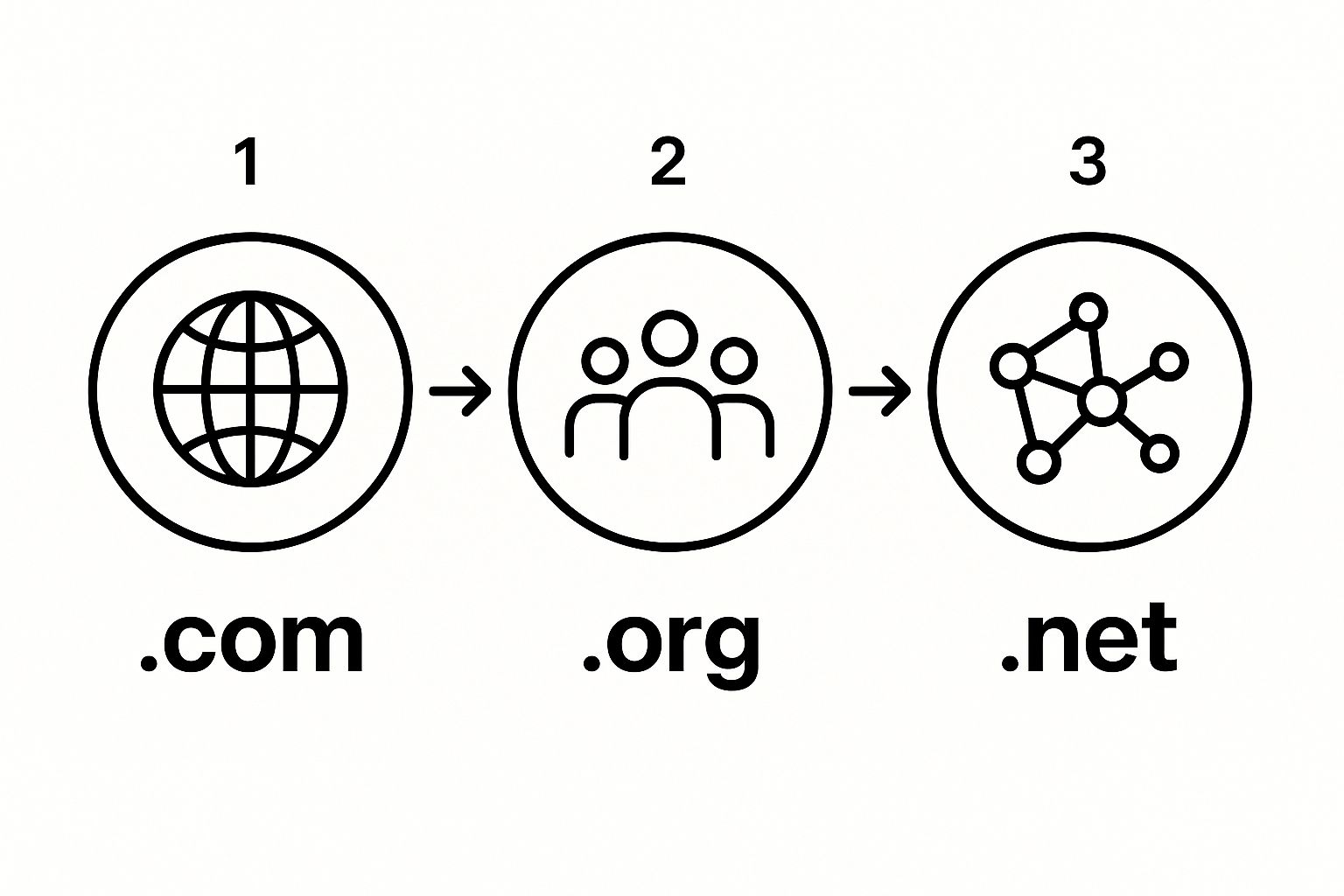
Each extension sends a slightly different signal, so it’s vital to choose one that aligns with what your business is all about.
Your Registration Checklist
Before you hit that "buy" button, it pays to run through these critical checks. Missing one of these could cause some serious headaches down the line. It's a quick process that protects your brand for years to come.
- Check for existing trademarks: This is a big one. A quick search on the UK's Intellectual Property Office website is essential. Choosing a name that steps on an existing trademark could land you in a costly legal dispute and even force a complete rebrand.
- Search for it on social media: Is the matching handle available on Facebook, Instagram, and any other platforms you plan to use? Consistent branding across all your channels is key to building a recognisable online presence for your West Lothian business.
- Opt for domain privacy protection: When you register a domain, your personal details (like your name, address, and email) often become public. Most registrars offer a privacy service that shields this information, protecting you from a flood of spam and unwanted contact.
- Register for multiple years: Securing your domain for at least two years does more than just save you a job next year. It shows search engines you’re in it for the long haul and prevents the nightmare scenario of forgetting to renew and losing your domain to a competitor.
The real goal of registration isn't just to own a name. It's to secure a clean, legally sound digital identity. A few minutes of research now can prevent months of potential trouble later.
The UK domain registrar market is clearly growing, with forecasts suggesting it will reach USD 58.79 million by 2033, largely driven by the boom in online businesses. This really highlights why choosing a registrar that offers solid protection and management services is so important. You can learn more about the growth of the domain registrar market in the UK.
Once your domain is secure, you can start focusing on the exciting part: building your website. If you need any help with the next steps for your business, feel free to get in touch with our web design team.
Common Domain Name Mistakes to Avoid
Choosing a domain name that actually works for your business means learning to spot the common pitfalls that can cause massive headaches down the line. I’ve seen so many well-meaning entrepreneurs accidentally hamstring themselves with names that are just too hard to spell, pronounce, or remember. That's the quickest way to kill any word-of-mouth buzz before it even starts.
Another classic mistake is picking a name that’s a bit too close for comfort to a competitor. Imagine you run a plumbing business in West Lothian called "Bathgate Plumbers." If a rival pops up with "Best Bathgate Plumbers," you've got instant brand confusion. You could be sending your hard-earned customers straight to their website by accident. Always, always do a quick search to make sure your idea stands on its own.
Being Too Specific or Too Clever
It’s tempting to be super descriptive with your domain, but getting too narrow can seriously limit your growth later on.
A name like LinlithgowWeddingCakes.co.uk feels perfect if that's all you ever plan to do. But what happens when you want to start offering birthday cakes or branching out into corporate events? Suddenly, your domain name has put your business in a very specific box.
The most effective domain names give your business room to evolve. Think about where you want to be in five years, not just today, and choose a name that can grow with your ambitions.
And then there's the risk of being too clever and creating an unintentionally embarrassing name. When you squash words together in a URL, they can sometimes create phrases you never intended. A now-famous example is a retailer whose site PenIsland.net was read in a... less than professional way.
Always read your domain idea out loud. Better yet, get a second or third pair of eyes on it to avoid a blunder that could be both costly and cringe-worthy.
FAQs: How to Choose a Domain Name in West Lothian
Getting to the final stages of choosing a domain name always seems to bring up a few last-minute questions. It’s completely normal. Here are some clear, practical answers to the most common queries we hear from business owners right here in West Lothian and across the UK.
Should I Buy Multiple Domain Extensions?
For most local businesses, grabbing both the .co.uk and the .com of your chosen name is a smart, defensive play. It’s all about brand protection. This simple step stops a competitor from registering the other version and potentially confusing your customers or poaching your traffic down the line.
Think about it—if you have big plans to expand beyond the UK one day, you'll be glad you have the .com. But even if you don't, it’s a small price to pay to secure your brand's digital footprint.
That said, if you're a small start-up laser-focused on the local West Lothian market, sticking with just the .co.uk is often more than enough and keeps initial costs down.
What if My Perfect Domain Name Is Taken?
It’s a gut-punch moment, isn't it? You find the perfect name, only to see it's already registered. But don't throw in the towel—this is rarely a dead end. Instead of starting from scratch, try a few creative tweaks:
- Pop a verb on the front: Think
Get[YourBrand].co.ukorTry[YourBrand].co.uk. It feels active and modern. - Add your location: Something like
[YourBrand]WestLothian.co.uknot only works but can also give you a nice little local SEO boost. - Try a different extension: If the .com is gone, is the .co.uk available? What about a .scot for businesses with a proud Scottish identity?
If the name is a real gem and crucial to your brand, you could look into using a domain broker. They’ll act as a middleman to try and buy the domain from its current owner. Be warned, though; this path usually comes with a hefty price tag.
The key is to find a memorable alternative without sacrificing brand quality. A slight, logical modification is always better than choosing a completely different, weaker name.
How Much Should a Domain Name Cost?
Let's clear up the confusion around domain pricing so you can budget properly. For a standard, brand-new domain name like a .co.uk or a .com, you should expect to pay somewhere in the region of £7-£15 per year.
You might also come across 'premium' domains. These are typically short, catchy, keyword-rich names that someone else registered ages ago and is now reselling. The price for these can be eye-watering, sometimes running into thousands of pounds.
One final tip: always watch out for hidden costs. Some registrars lure you in with a super-low first-year price, only to hit you with sky-high renewal rates. Always check the full cost over a few years before you commit.
For a bit more detail on this topic, have a look at this a comprehensive guide to choosing a domain name.