
Improve Your Ecommerce Web Design in West Lothian in Under 15 Minutes
Building a successful ecommerce website is about more than just a pretty design. It’s the entire process of creating a strategic, user-friendly, and secure online shop that turns browsers into buyers. Think of it as crafting the perfect customer journey, from the moment they land on your site to the final click of the "buy now" button.
Your Blueprint for Local Ecommerce Success
Before you even think about code or colour schemes, a winning online store starts with a rock-solid plan. For any business here in West Lothian, this means laying down a strategic foundation first. Rushing in without a clear blueprint is a recipe for costly mistakes and headaches down the road.
This initial planning stage is non-negotiable. It’s where you transform a vague idea into a concrete action plan, ensuring every decision you make—from the platform you choose to how you market it—lines up perfectly with what you want to achieve.
Defining Your Goals and Audience
First things first: who are you actually selling to? Is your ideal customer scrolling on their phone in Livingston, browsing on a laptop in Linlithgow, or are they somewhere else entirely? Getting to grips with your local audience is everything.
How to Define Your Audience and Goals:
- Create a Customer Persona: Outline their needs, online habits, and what they truly want from a shopping experience.
- Set Measurable Goals: Don't just aim to "sell more." Get specific.
- Establish Clear Targets: Aim for things like hitting 20 online sales per week within the first three months, cutting down cart abandonment by 15% in six months, or boosting local website traffic from West Lothian postcodes by 30%.
These kinds of precise goals give you a yardstick for success and keep the whole project on track.
Analysing the Competitive Landscape
Next up, it’s time for a bit of detective work. Take a good look at what your local competitors are doing online.
How to Analyse Your Competitors:
- Review Their Websites: Sift through their sites and figure out what they’re doing well and, more importantly, where they're falling short.
- Check Mobile Experience: Is their site a dream to use on a phone?
- Test Their Checkout: Is their checkout process a breeze or a nightmare?
This analysis is your chance to find the gaps and carve out your own unique space in the market.
A well-defined unique selling proposition (USP) is your greatest asset. It's the reason a customer in Bathgate will choose your store over a competitor. Clearly articulate what sets you apart, whether it's bespoke products, faster local delivery, or exceptional customer service.
The opportunity here is massive. The UK ecommerce market is projected to hit USD 265.14 billion in 2025, with an eye-watering compound annual growth rate of 22.73% through to 2030. As you can read on Mordor Intelligence, this boom is driven by new tech, making a strong digital presence more critical than ever. Nailing this planning stage puts your West Lothian business in the perfect position to grab a slice of that growing pie.
Choosing the Right Ecommerce Platform
The ecommerce platform you build on is the very foundation of your online business. It’s easy to get lost in a sea of feature comparison lists, but making the right call really comes down to a few key factors that will directly shape your ability to grow, especially for a business right here in West Lothian.
Don't just fixate on the monthly subscription fee. A common pitfall is ignoring the total cost of ownership. This includes hidden transaction fees, the cost of essential apps or plugins you'll inevitably need, and any custom development work that might crop up down the line. What seems like the cheaper platform today can quickly become the most expensive headache as your business scales.
Core Considerations for Local Businesses
Think about it this way: a local artisan in Bathgate probably needs a visually stunning, easy-to-manage shop above all else. But a growing retailer in Armadale? Their priority will be powerful inventory management and a system that won’t buckle under a high volume of orders. Your specific business model is what determines which features are nice-to-haves and which are non-negotiable.
How to Choose Your Platform:
- Check Scalability: Can this platform actually grow with you? You need something that can handle a sudden surge in traffic from a viral post or a big sale without crashing or forcing you into a costly migration in a year.
- Prioritise Flexibility: How much control do you have over the look and feel? A good platform lets you build a unique brand experience that doesn’t scream "I used a generic template."
- Demand Ease of Use: Honestly, how simple is it for you and your team to add products, process orders, and update the site? A clunky, complicated backend will just slow you down and become a source of daily frustration.
- Calculate Total Cost: Look beyond the sticker price. Add up the full cost: themes, apps, payment processing fees, and any specialist help you might need to get things just right.
This decision tree can give you a clearer picture of how to approach your layout strategy, which is a key part of your user experience that's heavily influenced by your platform choice.
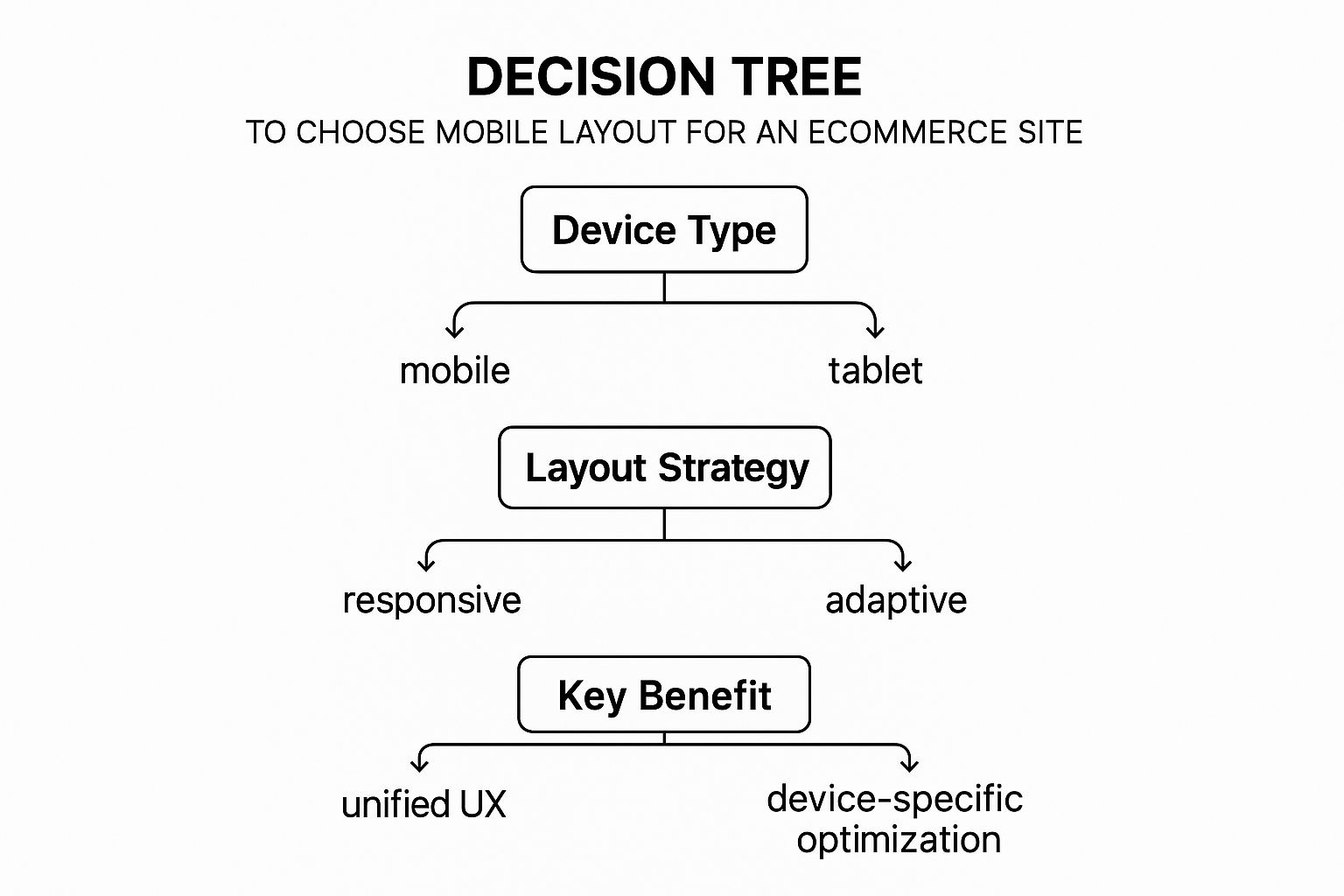
As the infographic shows, you're essentially choosing between a unified experience with responsive design or a more device-specific, optimised layout using an adaptive approach. Your platform can make one of these paths much easier than the other.
Ecommerce Platform Comparison for UK Businesses
To help you navigate the main players in the market, here is a quick comparison of the top platforms. This table focuses on what matters most for small to medium-sized businesses here in the UK and West Lothian, cutting through the marketing noise to give you a clear, side-by-side view.
| Platform | Best For | Pricing Model | Key Strengths | Potential Drawbacks |
|---|---|---|---|---|
| Shopify | Beginners and businesses wanting an all-in-one solution. | Monthly Subscription + Transaction Fees | Incredibly user-friendly, fast to set up, excellent support, and a huge app store. | Transaction fees on non-Shopify Payments, customisation can be limited without coding knowledge. |
| WooCommerce | Businesses that want full control and already use WordPress. | Free Plugin (Hosting & other costs are separate) | Unmatched flexibility and customisation, no transaction fees, massive community support. | Steeper learning curve, you're responsible for security, hosting, and maintenance. |
| BigCommerce | Growing businesses and B2B sellers needing built-in features. | Monthly Subscription (No Transaction Fees) | Strong out-of-the-box features (no transaction fees), good for SEO, handles large product catalogues well. | Can be more complex for beginners, and the theme selection is smaller than Shopify's. |
Ultimately, the "best" platform is the one that best fits your specific business goals and technical comfort level. Each of these contenders can be a fantastic foundation, but they are built for slightly different journeys.
Comparing the Top Contenders
Most businesses find their perfect match among three leading platforms: Shopify, WooCommerce, and BigCommerce. Each one has carved out its own niche by catering to different business needs.
Choosing a platform is a long-term commitment. Think about where you want your business to be in three to five years, not just where it is today. The right foundation prevents disruptive and expensive platform changes as your business succeeds.
WooCommerce, for instance, is a plugin for WordPress, which gives it almost limitless potential for customisation. It's a fantastic choice if you already have a WordPress site or if you want complete creative control over every pixel. For a deeper dive, WhatArmy's detailed guide does a great job of exploring the core components of building a powerful online store.
Shopify, on the other hand, is a fully hosted solution prized for its simplicity and how quickly you can get a store up and running. It's the ideal all-in-one package for anyone who doesn’t want to get their hands dirty with technical maintenance.
Designing an Experience That Converts Shoppers
A visually stunning website is great, but let's be honest—it’s an intuitive and seamless experience that actually drives sales. The real magic of effective e-commerce web design and development isn’t just about making things look pretty; it's about building a user experience (UX) and user interface (UI) with one goal in mind: conversion.
That means we're creating a smooth, logical path for your customers, guiding them effortlessly from the moment they land on your homepage right through to that final checkout click. It all comes down to understanding how people actually behave online and using that insight to steer them gently towards a purchase. Everything from clear navigation and compelling product photos to persuasive calls-to-action (CTAs) plays a part.
Building Trust with West Lothian Shoppers
When you're selling to a local market like West Lothian, trust is everything. Your customers need to feel completely secure before they’ll even think about entering their payment details. Weaving that confidence into your design is non-negotiable.
How to Build Credibility with Local Shoppers:
- Showcase Customer Reviews: Put genuine reviews and testimonials from other local shoppers front and centre. There's nothing more powerful than social proof.
- Display Security Badges: Make sure the logos for trusted payment options like Visa, Mastercard, and PayPal are clearly visible, especially around the checkout area.
- Provide Clear Contact Information: An easy-to-find phone number and a physical address in West Lothian show there's a real, accountable business behind the screen.
As you can see, a great user experience is a mix of many disciplines—visual design, information architecture, usability, and more—all working together. When done right, the results speak for themselves.
Optimising for Conversion
Getting your design right isn't a one-and-done task; it’s a continuous process of refinement. It's all about making small, data-driven tweaks that can lead to big improvements in your sales. If you're looking for a deep dive, exploring various conversion rate optimization tips can give you ideas for every stage of the customer journey.
A mobile-first design isn't just a good idea anymore—it's essential. The vast majority of online traffic now comes from smartphones, so your site absolutely must offer a flawless experience on smaller screens. A clunky mobile interface is a guaranteed way to lose customers in West Lothian.
The impact of a well-optimised design is undeniable. In the UK, online retail growth is leaving traditional retail in the dust. For instance, e-commerce sales recently jumped 11.78% year-over-year, massively outpacing the 3.1% growth in general retail. Well-designed platforms aren't just selling more; they're also seeing customer acquisition costs drop, proving that great design is one of the smartest investments you can make.
Building a Fast and Secure Online Store
Beneath the surface of a great-looking e-commerce site lies the technical engine that really drives its success. The most crucial parts of e-commerce web design and development aren't always what you see; they're the elements that make your store fast, secure, and totally reliable for every visitor.
A slow website is a conversion killer. It’s that simple. Modern shoppers expect pages to load almost instantly, and even a one-second delay can send your bounce rate through the roof. This isn't just about keeping customers happy, either. Page speed is a massive ranking factor for Google, directly impacting how easily shoppers in West Lothian can even find you.
The Foundations of a High-Performing Store
Building a fast website is about more than just picking a good hosting provider. It requires a laser focus during development to ensure every single component is optimised for speed. Think of clean, streamlined code as the bedrock of a high-performing site.
How to Improve Your Site Speed:
- Optimise Your Images: Compress all your product photos and graphics without sacrificing quality. Trust me, large image files are one of the biggest culprits behind slow load times.
- Leverage Browser Caching: Set up your site to store parts of your webpage in a visitor's browser. This means it doesn't have to reload everything from scratch on their next visit, making things much quicker.
- Minify Code: Strip out unnecessary characters from your site's code, like extra spaces and comments. This trims down file sizes and speeds up processing.
- Use a Content Delivery Network (CDN): A CDN stores copies of your site on servers across the globe. When a customer visits, it delivers content from the server closest to them, which dramatically cuts down loading time.
These steps are part of a much bigger picture when it comes to creating a solid online presence. For more insights, you can explore some effective general web design tips and tricks that build on these technical foundations.
Locking Down Your Security
Security isn't an optional extra; it's a fundamental requirement. Your customers are trusting you with their personal and financial details, and any breach of that trust can be absolutely devastating for your reputation.
An SSL certificate is the absolute baseline for e-commerce security. It encrypts the connection between a customer's browser and your server, protecting sensitive data. Modern browsers actively warn users away from sites that are not secure, making SSL non-negotiable.
Beyond SSL, real security means integrating trusted and recognisable payment gateways like Stripe or PayPal. These providers handle the heavy lifting of security and compliance for you, giving both you and your customers peace of mind.
To keep your store secure and profitable, it's also vital to implement comprehensive strategies for e-commerce fraud prevention. Taking a proactive approach like this helps protect your revenue and builds the kind of confidence that turns one-time buyers into loyal customers.
Launching and Growing Your Ecommerce Site
Hitting the ‘go live’ button is a massive moment, but let's be clear: it’s the starting line, not the finish. The real work in ecommerce web design and development truly kicks in once your site is out in the wild. A successful online store isn't built on a flawless launch day; it’s forged in a constant cycle of testing, learning, and improving based on what real customers are doing.
Think of your brand-new website as a well-educated guess. You believe its design, product descriptions, and checkout flow are what your customers want. Now it's time to gather the evidence to see if you were right and make smart adjustments along the way.
Your Pre-Launch Checklist
Before you start shouting about your new site from the rooftops, a final, meticulous check is essential. It helps you dodge those simple but potentially damaging first impressions. Running through a detailed list ensures your first wave of visitors get a smooth, professional experience, which is absolutely vital for building that initial trust.
How to Conduct a Pre-Launch Check:
- Test Payment Processing: Don't just simulate it—run a real transaction from start to finish. Make sure the payment actually goes through, the order pops up in your back-end, and all the confirmation emails fire off as they should.
- Check All Links and Buttons: Get clicking. Every single link, button, and call-to-action needs a test. Pay close attention to your main menu, footer links, and any promotional banners you’ve set up.
- Submit All Forms: Fill out every contact and enquiry form on your site. Did the submission come through to your inbox? Did the auto-responder email trigger correctly?
- Review the Mobile Experience: Grab your smartphone and go through the entire buying journey. Is it a breeze to browse products, add them to the cart, and check out on a small screen? Or is it a frustrating pinch-and-zoom nightmare?
Shifting to Data-Driven Growth
Once you’re live, your mindset has to shift from building to analysing. Tools like Google Analytics aren't just a nice-to-have; they’re your eyes and ears, showing you exactly how visitors from West Lothian and beyond are interacting with your shop. Don't let the sheer amount of data intimidate you. Just start by tracking a few key metrics that directly impact your sales.
Your two most important initial metrics are your conversion rate (the percentage of visitors who make a purchase) and your cart abandonment rate. These two numbers tell you how effectively your site is turning traffic into sales and where you might be losing customers in the final steps.
This focus on continuous improvement is what separates the winners from the losers in the competitive UK market. By 2025, the UK is expected to have 62.1 million online shoppers, with nearly 31% of all retail spending happening online. The UK's ecommerce sector accounts for the highest proportion of GDP in Europe, making it a massive opportunity for businesses that get it right.
But data alone doesn't tell the whole story. Gathering direct feedback through simple surveys or post-purchase emails gives you the 'why' behind the numbers. Combine this qualitative insight with A/B testing—trying out different headlines or button colours—to constantly fine-tune your approach. This ongoing process is what turns a static website into a dynamic, intelligent sales engine.
Your Ecommerce Questions Answered
When you're thinking about building an online shop, a lot of questions pop up. It's only natural. We've worked with businesses across West Lothian, from Livingston to Bathgate, and the same key concerns come up time and time again.
Let's clear the air and tackle those big questions head-on.
How much does an ecommerce website cost in West Lothian?
This is always the first question, and the honest answer is: it really depends. There's no one-size-fits-all price tag. A simple starter site using a Shopify template might begin at a few thousand pounds, but a completely custom build with unique features and integrations will be a more significant investment. The final figure really boils down to your chosen platform, design complexity, and any custom features required.
How long will it take to build an online store?
Much like the cost, the timeline can vary quite a bit. A straightforward, template-based online shop can be launched in as little as 4-6 weeks. On the other hand, a large-scale custom project with deep design work, complex development, and rigorous testing can take 12-16 weeks, sometimes longer. A key factor is how quickly you can provide content and product information.
Can I manage the website myself afterwards?
Yes, absolutely! That's the whole point. Modern ecommerce platforms like Shopify and WooCommerce are designed for business owners, not developers. Once we've built the site and handed over the keys, you'll be able to handle all the essentials yourself, such as adding products, creating discounts, and processing orders, with no technical skills needed.
Which is the best ecommerce platform for a small business?
For most small businesses in West Lothian, Shopify is an excellent starting point due to its ease of use and all-in-one nature. However, if you already have a WordPress site or require deep customisation, WooCommerce is a powerful and flexible alternative. The best platform depends on your specific budget, technical comfort, and long-term goals.
Do I need a developer for my ecommerce site?
While platforms are user-friendly, a professional developer is crucial for initial setup, security, performance optimisation, and creating a custom design that stands out. For businesses in West Lothian, a local expert in ecommerce web design and development can ensure your site is built to best practices from day one, saving you headaches and lost sales down the line.